
How Magnetic Polishing Works
No fixtures, no tooling, no manual contact. A magnetic field does the work — and reaches places a belt, mop or vibratory bowl never will.
The Principle
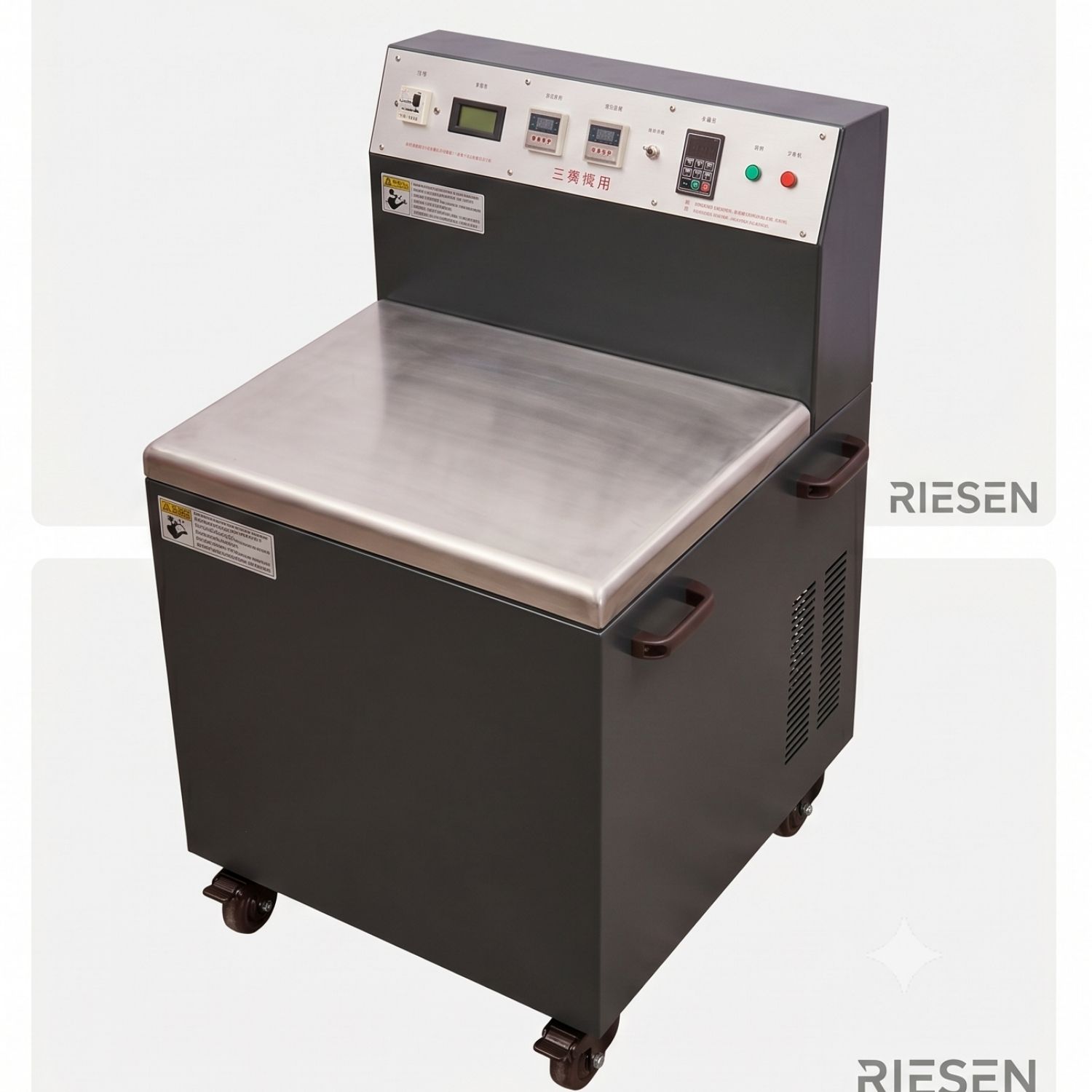
A rotating magnetic field drives thousands of small stainless-steel pins through a bucket of water and polishing compound. The pins flow, rotate and tumble through and around the parts, abrading edges, burrs, scale and oxide — with no fixture, no tooling and no manual contact. Because the pins are tiny and follow the magnetic field rather than a fixed path, they reach the places fixed media cannot.
Reaches What Others Can’t
The pins go where belts, mops and vibratory media stop:
- Blind holes
- Internal threads
- Slots, recesses and undercuts
- The interior surfaces of drawn and formed parts
No Dimensional Change
The pins carry the abrasion, not the part. Dimensions are unaffected and parts are not deformed. This is the difference from vibratory finishing and from manual buffing, both of which can round edges and shift tolerances. It is why the process suits threaded fasteners, precision-turned parts and thin drawn components that other methods damage.
One Cycle, Five Operations
A single automated cycle performs five jobs at once:
- 01
Deburring
- 02
Descaling
- 03
Oxide removal
- 04
Polishing
- 05
Brightening
The operator only loads, runs, unloads, rinses and dries. Materials handled include stainless steel, brass, copper, aluminium, zinc and die-cast alloys, spring steel and titanium.
How It Compares
| Method | Complex geometry (holes, threads) | Edge & dimensional safety | Consistency | In-house / turnaround |
|---|---|---|---|---|
| Manual buffing | Misses internal features | Can round edges | Operator-dependent | In-house but labour-heavy |
| Job-work outsourcing | Vendor-dependent | Vendor-dependent | Batch to batch | Parts leave the factory; transit and minimums |
| Vibratory finishing | Struggles on complex parts | Media can round edges | Moderate | In-house |
| Magnetic polishing | Reaches holes, threads and recesses | No dimensional change | Repeatable | In-house, same-day |
The Recipe Matters
The machine is only half the answer. The media, the compound concentration, the cycle time and the speed all have to be matched to your part geometry. Get the recipe wrong and parts come out scratched or under-finished. Developing that recipe for your specific parts is part of what we supply — which is why we ask for samples first.
See real results