
11 August 2026
What Are Magnetic Polishing Machines, and Why They Fit MSME Manufacturing
A plain explanation of how magnetic polishing machines work, what one cycle replaces, and why the process suits the batch sizes, labour constraints and part variety of small and mid-sized manufacturers.
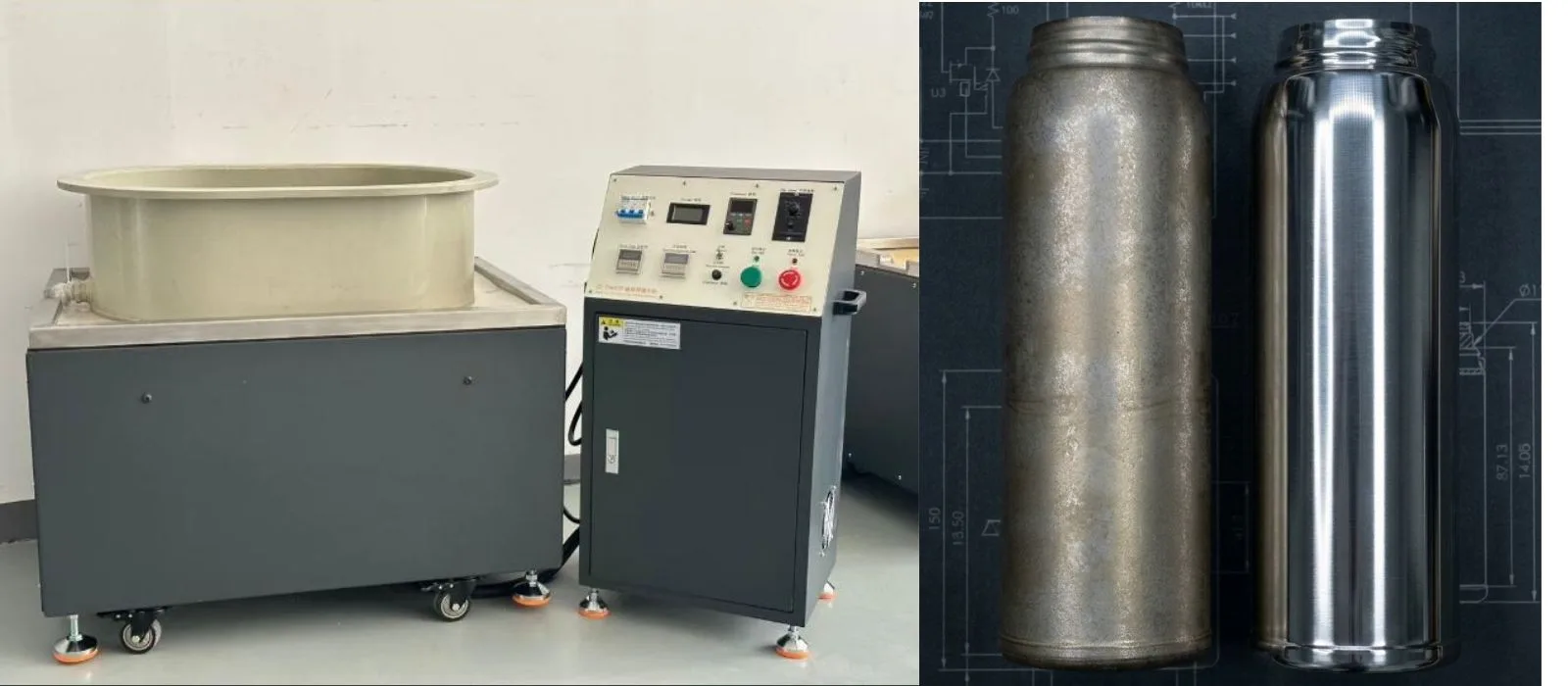
Before Riesen Engineering distributed magnetic polishing machines, we bought one for ourselves. We were finishing parts by hand in our own plant — three operators, buffing wheels, and a finish that changed depending on who was on shift that day. We sell what we use, and most of what follows comes from running these machines on our own floor rather than from a brochure.
What a magnetic polishing machine actually is
A magnetic polishing machine finishes small metal parts using stainless steel pins driven by a rotating magnetic field. The parts, the pins and a liquid compound go into a container that sits over the magnetic head. When the machine runs, the field makes the pins spin, tumble and reverse at high speed through the liquid, brushing against every exposed surface of every part in the batch at once.
The important detail is where the abrasion happens. The pins carry the work, not the part. Because the pins are small and independently driven, they reach blind holes, internal threads, slots, recesses and the insides of drawn or formed parts — geometry that a buffing wheel cannot touch and that vibratory media is usually too large to enter. And because nothing is being pressed against the part under mechanical load, the process does not round edges or shift dimensions.
That last point is the reason it exists as a category. Manual buffing and vibratory finishing both remove material from the part surface, which is precisely what causes rejections on threaded, tolerance-critical or thin-walled components.
What one cycle replaces
A single automated cycle carries out deburring, descaling, oxide removal, polishing and brightening. In a manual shop those are usually separate stages, sometimes on separate days, sometimes at separate vendors.
The materials it handles cover most of what an MSME job shop sees: stainless steel, brass, copper, aluminium, zinc and die-cast alloys, spring steel and titanium.
Why magnetic polishing suits MSME manufacturing
Small and mid-sized manufacturers have a specific set of constraints, and this process happens to fit them.
Mixed batches, not one part forever. A job shop runs twenty different components in a month. The pins do not need to be reprofiled or changed for each geometry the way a wheel or fixture does.
Finishing is where skilled labour is hardest to hold. Hand polishing is unpleasant work, and the quality walks out of the gate when the operator does. One operator running a machine is a far easier position to staff.
Consistency is what customers audit. A batch finished by machine looks the same at the start and the end. A batch finished by hand does not.
Outsourcing costs time, not just money. Parts sent out for polishing come back in three to seven days, with a minimum batch size, and some of them do not come back at all — lost, mixed, or damaged in transit.
For a smaller unit starting on an entry-level machine from our Single Bucket Series, the case is usually the outsourcing one rather than the labour one: same-day turnaround, no minimum batch, and nothing lost between your gate and the vendor's.
Magnetic polishing cost per kg on a production machine
On a production-volume machine, the economics change from turnaround to cost per kilogram. These are our own plant figures, hand finishing versus a machine from the Translational and Magnetic Levitation Series:
Chemical and compound: ₹7.50 → ₹5.00
Labour: ₹6.60 → ₹1.10
Power: — → ₹0.36
Polishing pins: — → ₹0.37
Total: ₹14.10 → ₹6.83 per kg
The output shift behind those numbers: three operators finishing 300–400 kg a day by hand, against roughly 700 kg per eight-hour shift with one operator on a production machine.
The honest part
This does not apply everywhere.
Those per-kg figures belong to production-volume machines. On an entry-level single bucket unit, the same operator cost spreads across far less material, so do not buy one expecting ₹6 per kg — buy it to stop outsourcing.
Magnetic polishing is a small-parts process. Large weldments, heavy fabricated assemblies and long sheet-metal panels are not its work; those belong on sheet-metal or sanding-belt deburring machines, which are a different line entirely.
It is also not a substitute for grinding. It removes burrs, scale and oxide and brightens the surface. It will not correct a machining error or take out a deep gouge.
And the pins are consumable and not available in the local market — we supply them, and you should factor that into how you plan the process.
If you want to know what your specific component looks like after a cycle rather than take our word for it, send us a handful of sample parts. We run them free of charge on the machine that suits the geometry, courier them back, and you can judge the finish in your own hands. Machines are held in stock at our Faridabad facility if you would rather come and watch a batch run. Details on contact.