
03 August 2026
What Magnetic Polishing Costs Per Kilogram — Our Own Plant Figures
Most equipment sellers hand you a savings spreadsheet. Ours is different — these are the numbers from our own floor, before and after we replaced hand polishing with a magnetic polishing machine.
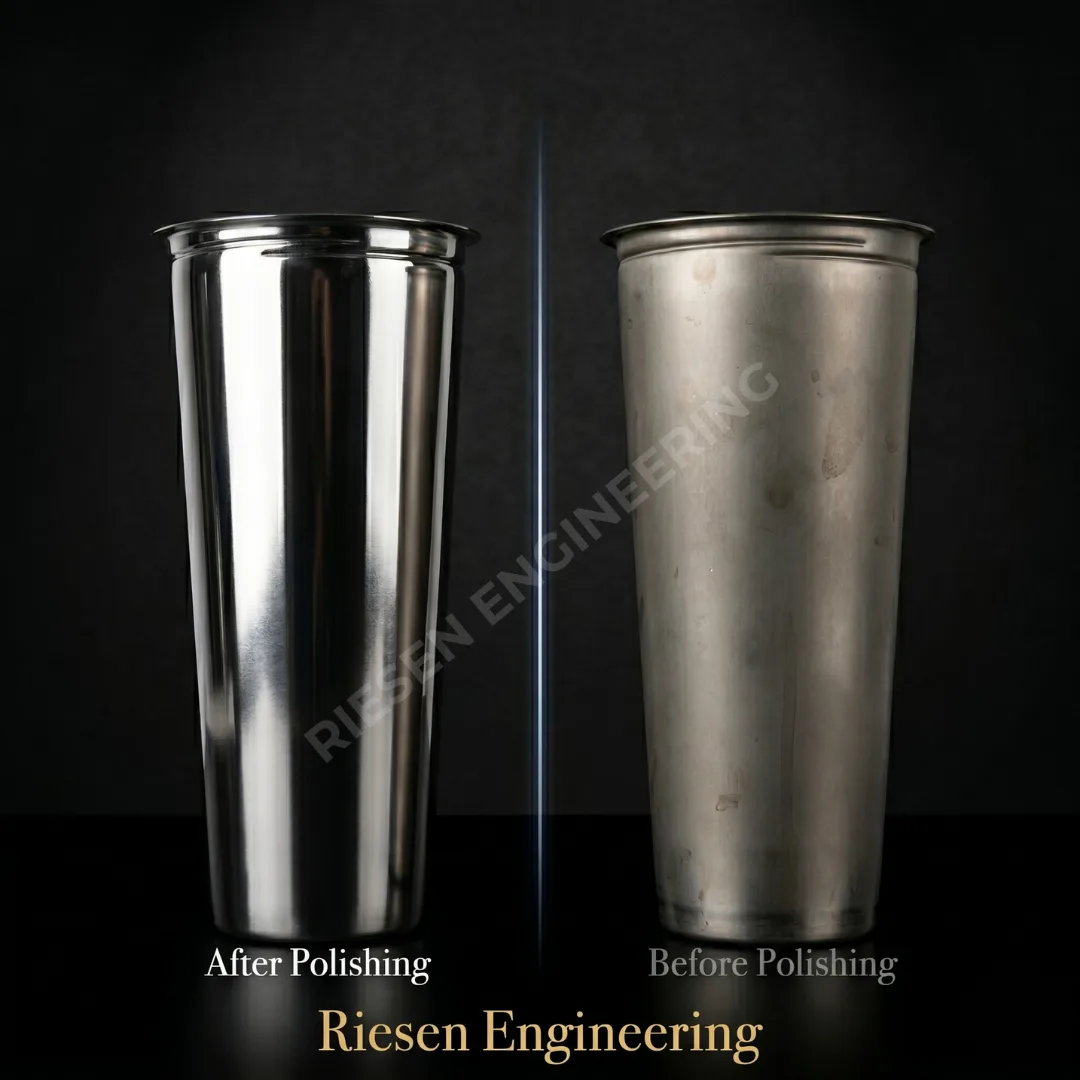
Ask most machine sellers what their equipment will save you and they hand you a spreadsheet. The trouble is that the numbers are theirs, built to sell a machine. Ours are different. Before Riesen Engineering sold magnetic polishing machines, we finished parts by hand in our own plant — so the figures below are not a projection. They are what we measured on our own floor, before and after the switch.
How we polished before
For years we finished parts by hand. Three operators, 300 to 400 kilograms a day, and a finish that was never quite consistent from one batch to the next. Chemical consumption ran high, labour ran higher, and the result depended on who was at the bench that day.
What changed
We moved the same work onto one production magnetic polishing machine. Output rose to around 700 kilograms in an eight-hour shift with a single operator — and the finish became repeatable, because it no longer depended on hand skill. The operator loads, runs, unloads, rinses and dries; the machine does the finishing, reaching the threads, recesses and internal features that a mop or belt never could.
The cost, per kilogram
Here is the part that matters. Broken down per kilogram of material processed, by hand versus on the machine:
Chemical / compound: ₹7.50 by hand → ₹5.00 by machine
Labour: ₹6.60 by hand → ₹1.10 by machine
Power: negligible by hand → ₹0.36 by machine
Polishing pins: none by hand → ₹0.37 by machine
Total: ₹14.10 by hand → ₹6.83 by machine
Roughly ₹6–7 per kilogram on a production machine, against about ₹14 per kilogram by hand. The labour line does most of the work — one operator in place of three — but the compound saving is real too, because a controlled cycle uses less than an open bench does.
What it means for payback
At production volumes, a saving of around ₹7 a kilogram adds up fast. For a shop processing a few hundred kilograms a day, a production machine often pays for itself inside a year — which is exactly why we ask buyers to compare running cost per kilogram, not purchase price.
The honest part
This economics holds for production-volume machines, where one operator finishes a large batch. It does not hold for the small, entry-level machines: there, the operator cost spreads over far less material and the labour saving narrows. Entry-level machines earn their place a different way — by bringing outsourced polishing back in-house, with same-day turnaround, no minimum batch, and nothing lost in transit. We will always tell you which case you are in.
Why we can show you this
No projection and no vendor spreadsheet. We ran manual polishing at scale, and we run these machines now, in the same plant. That is the one figure a catalogue cannot give you — and it is the reason we would rather finish your own parts, free, than argue over a table.
Send us a sample of your components. We will finish them, work out the cost per kilogram for your specific parts, and courier them back — so you can judge both the finish and the figure before you decide anything.